Discernment Counseling Rochester Hills
When One
Spouse Is Leaning Out and the Other Is Leaning In

When one spouse is thinking seriously about divorce and the other wants to save the marriage, traditional couples counseling may not be the right place to begin.
You may both be asking very different questions.
One of you may be wondering, “Is there enough here to keep trying?”
The other may be wondering, “How can we give up without really trying to repair this?”
Discernment Counseling is designed specifically for couples in this situation.
Rather
than pushing you toward reconciliation or toward divorce, Discernment
Counseling gives you a structured place to slow down, look carefully at
what has happened in your relationship, and decide what direction makes
the most sense from here.
When One Spouse Is “Leaning Out”
and the Other Is “Leaning In”
Discernment Counseling is particularly helpful for what are sometimes called mixed-agenda couples.
One
spouse may be “leaning out” of the marriage—questioning whether the
relationship can or should continue and feeling uncertain about
beginning traditional marriage counseling.
The other spouse may be “leaning in”—wanting to preserve the marriage and willing to work toward rebuilding it.
Trying
to begin ordinary couples therapy when the two of you have such
different goals can be frustrating for everyone involved. Discernment
Counseling starts by acknowledging those difference rather than
pretending you are both ready to work on the marriage in the same way.
The Goal Is Clarity, Not Pressure
Discernment Counseling is not designed to convince you to stay married. It is also not intended to move you toward divorce.
Instead, the goal is to help each of you gain greater clarity and confidence about your next step.
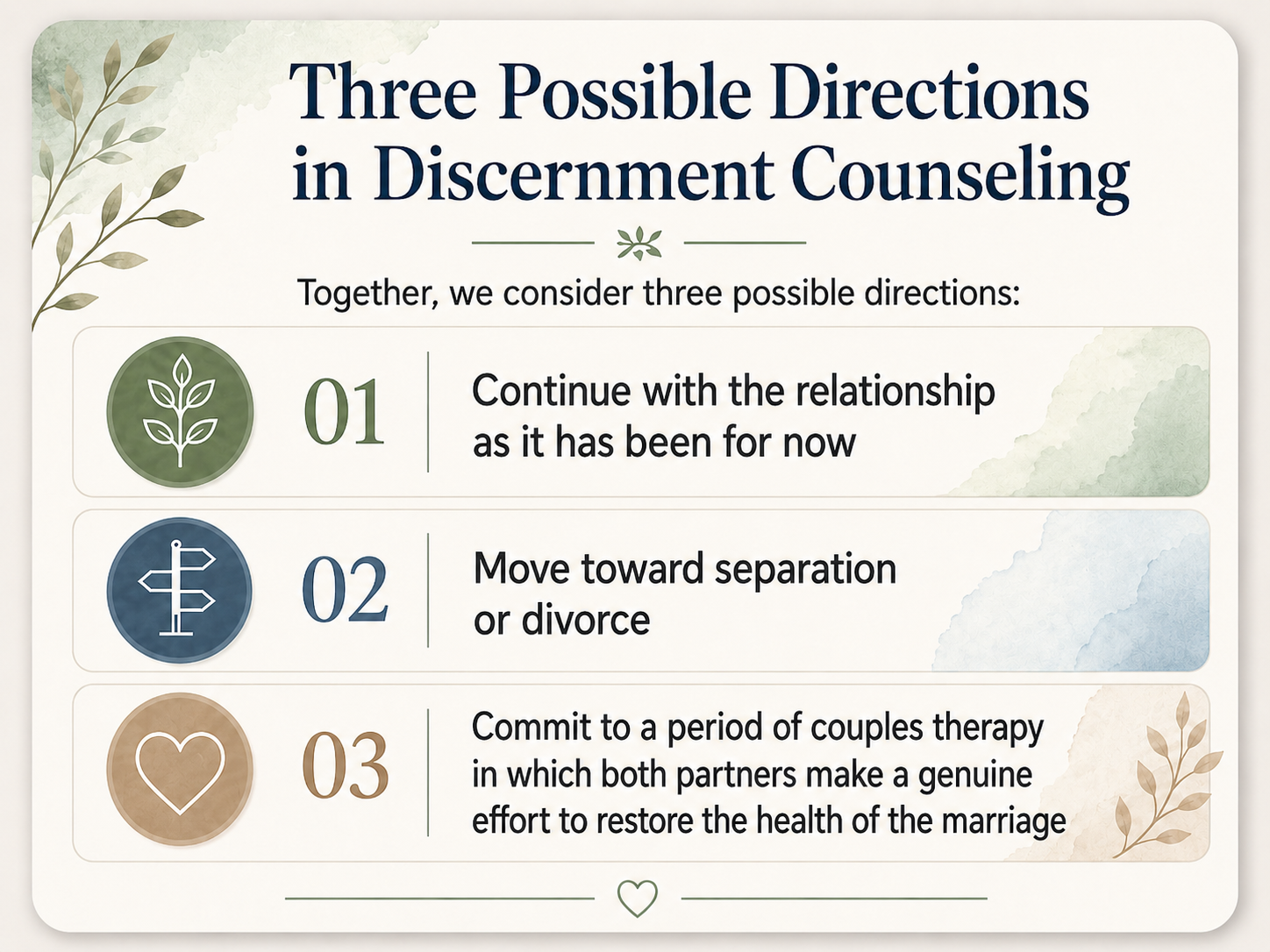
Together, we consider three possible directions:
- Continue with the relationship as it has been for now
- Move toward separation or divorce
- Commit to a period of couples therapy in which both partners make a genuine effort to restore the health of the marriage
The
purpose is not to solve your marital problems during Discernment
Counseling. The more immediate question is whether those problems may
be workable—and whether both of you are willing to find out.
Understanding What Happened in Your Marriage
An important part of the process is developing a clearer understanding of how your relationship arrived at this point.
That does not mean deciding that one spouse is the “good guy” and the other is the “bad guy.”
Both
partners are treated with respect, including the spouse who is
considering divorce and the spouse who hopes to preserve the marriage.
You
will each have an opportunity to look honestly at your own part in the
relationship—patterns, choices, hurts, reactions, and contributions that
may have affected the marriage.
That understanding can be
valuable regardless of the direction you ultimately choose. If you
decide to work on the marriage, it helps identify what needs to change.
If the marriage ends, the insight you gain can still be important for
your future relationships and family life.
What Happens During Discernment Counseling?

You
attend Discernment Counseling as a couple, but much of the important
work takes place in individual conversations with the counselor during
each session.
There is a reason for that.
When one spouse
is leaning toward divorce and the other is hoping for reconciliation,
you are beginning the process from very different emotional positions.
Separate conversations allow each of you to speak candidly, examine your
own thinking, and consider your next steps without turning the session
into a debate about whether the marriage should continue.
I
respect the concerns and experiences that have led one partner to
consider ending the marriage, while also taking seriously the
possibility that meaningful change may still be possible.
How Long Does Discernment Counseling Take?
Discernment Counseling is intentionally brief.
Couples
may participate in up to five sessions. The first session is generally
about two hours, with later sessions typically lasting approximately 90
minutes to two hours.
You do not have to commit to all five
sessions in advance. The process continues only as long as it is helping
you move toward greater clarity.
What Discernment Counseling Rochester Hills Cost?
Discernment Counseling is a short-term, focused process of 1 to 5 sessions designed to help you and your spouse gain clarity and confidence about what to do next in your marriage.
Because the process is brief and highly structured, you are not committing to months of ongoing counseling.
First session: 2 hours — $325
Additional sessions: 90 minutes — $250 each
Most couples decide after each session whether another session would be helpful. You do not need to commit to all five sessions in advance.
Do You Accept Insurance for Discernment Counseling?
No. Discernment Counseling is a specialized decision-making process rather than traditional ongoing couples therapy, and it is typically not billed to insurance.
Insurance generally requires treatment to be connected to a mental health diagnosis and medically necessary psychotherapy. Discernment Counseling has a different purpose: helping partners who may have different goals for the marriage carefully consider whether to stay as they are, move toward divorce, or make a serious commitment to couples therapy.
Payment is required at the time of session. A credit card deposit may be required to reserve a 2-hour session.
When Discernment Counseling Is Not Appropriate
Discernment Counseling is generally not appropriate when:
- One spouse has already made a final decision to divorce and is no longer genuinely considering another path
- One spouse is being pressured or coerced into participating
- There is current domestic violence or a concern that participating together could place either partner at risk
If
you are uncertain whether Discernment Counseling fits your situation,
we can talk briefly about what is happening in your marriage and
determine whether this approach—or another kind of support—would be more
appropriate.
Return Home from Discernment Counseling Rochester Hills